
Will “half of all family lines” vanish in 50 years? — Why recording your family matters now
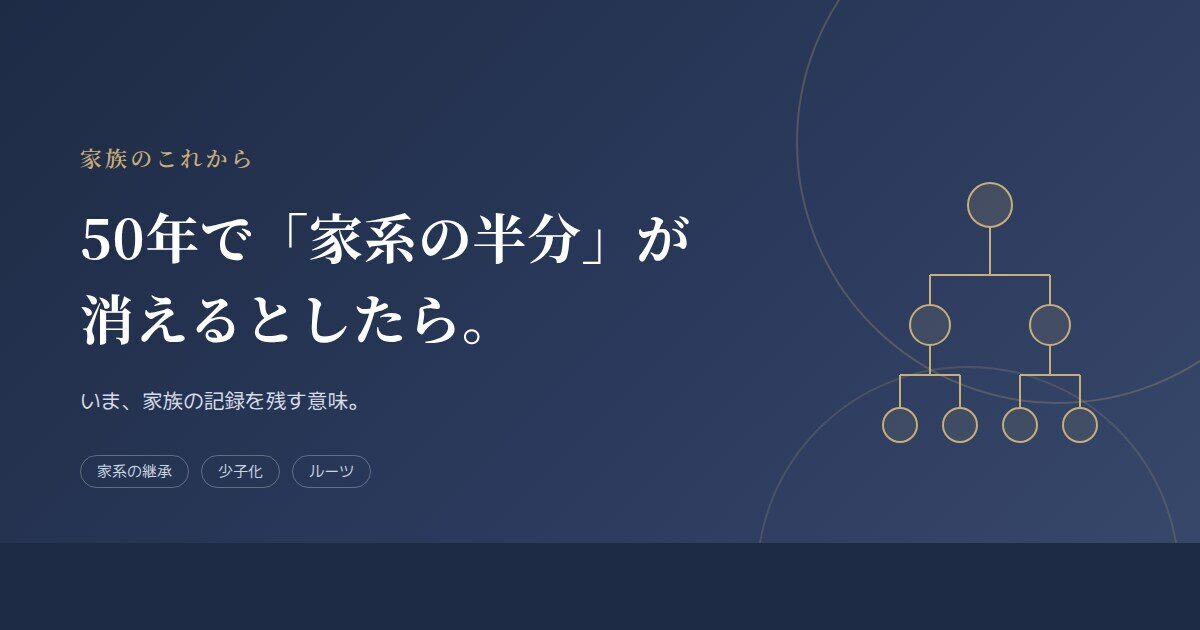
“Will our family line carry on into the future?” — Have you ever found yourself wondering that? In Japan, where the birthrate keeps falling, it has been pointed out that many family lines will end without being passed on to the next generation. One estimate even suggests that over the next 50 years or so, roughly half of Japan's family lines will die out, and that about 40% of women now in their 20s will belong to a generation without grandchildren.
Why do family lines come to an end?
Behind this are fewer births and more people marrying late or not at all. As the generations of children and grandchildren grow smaller, the number of “households” that get passed on shrinks as well. The vertical bond “from ancestors to descendants,” once taken for granted, is quietly growing thinner.
When a family line ends, it is not simply that a surname stops continuing. The history that family has walked through, and the memories of what kind of lives the grandparents led, are also lost without being handed down.
What happens when a family line ends?
Of the things left behind, there are three major ones.
Graves, Buddhist altars and family trees
Under the law, too, graves, Buddhist altars and family trees (genealogies) are treated separately from other property and are inherited by “the person who presides over the rites for the ancestors” (Civil Code, Article 897). A grave with no one to take it over may, after a public notice period, be cleared as an “untended grave.” More and more families are choosing to close their graves or arrange perpetual memorial services before that happens.
The family register
When everyone listed in a family register (koseki) has passed away or otherwise left it, the register becomes a “closed register” (joseki) and is kept by the city, ward, town or village office. It is kept for 150 years (extended from 80 years by a 2010 revision). Put the other way around, some old closed registers whose period expired before the revision have already been discarded.
Family memories
What is most easily lost is what never makes it onto paper. A family register records only facts such as names, dates of birth and relationships; it says nothing about what work your grandparents did or what kind of people they were.
“Continuing” and “preserving”
Keeping a family line itself going is not easy. But “preserving as a record” your family's journey and memories is something you can start today. In fact, precisely because family lines are growing thinner, the value of keeping a record is only rising.
Your grandparents' names, the places they were born, small stories about your family. If you preserve each of these together with a family tree and photos, your family's roots can be passed on to the future even if the family line grows thin.
Family Storage is a service where your whole family can safely store and share family trees, photos and stories. In an age when “continuing” is hard, why not start at least with “preserving”?
What you can do now, before it ends
- Collect the family registers — The sooner you obtain old closed registers and pre-revision registers (kaisei genkoseki), the more reliably you can get them. See How to request family registers for the steps.
- Put it together as a family tree — See What is a family tree? for how to make one. The Family Map on Family Storage is free to use.
- Write down their stories — While your grandparents and relatives are still well, ask them about where they were born, their work and their memories.
- When researching on your own is difficult — With our family tree research service (Family Research), we trace the family registers and research your ancestors going back about 150 years.
* This article is a plain introduction to general observations and estimates about the falling birthrate and family lines. Figures are based on the estimates and views of the original sources.
Reference: Meiji University, Meiji.net, “Will half of Japan's family lines disappear?” https://www.meiji.net/topics/trend20191004
Laws: Civil Code, Article 897 (Succession to rights relating to rites); Ordinance for Enforcement of the Family Register Act (retention period for closed registers)

Comments (0)
No comments yet. Be the first to comment.