
Words you will find in family registers — a starter glossary for reading old registers
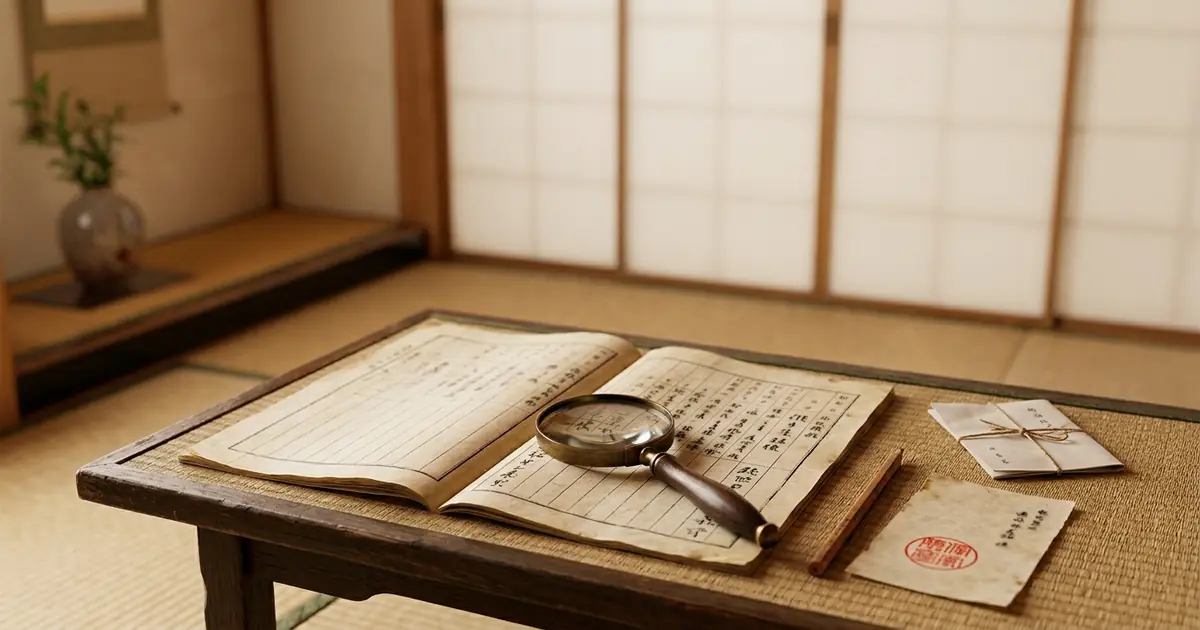
You have ordered an old family register (koseki), but you cannot read the words written in it. This is where many people making a family tree stop for a while. “Koshu,” “katoku sōzoku,” “inkyo,” “zekke” — none of these words are used in daily life today.
In this article, we explain the words found in family registers, grouped by “where you will meet them.” We have added the readings too. There is no need to memorize them all. It is enough to look up only the ones that appear in the register you have, as you come across them.
First, a Map of the Eras
Family registers have been remade each time the law was revised. The words that appear change with the format. Once you know which era your register comes from, reading it becomes much easier.
- Meiji 5 format (Jinshin Koseki)1872– — ★These can no longer be viewed. They contain entries about social status and have been sealed
- Meiji 19 format1886– — In most cases, this is as far back as you can actually go
- Meiji 31 format1898– — The whole household is entered in one register, centered on the “head of household”
- Taisho 4 format1915–
- Showa 23 format1948– — ★This is where the “ie” (household) system ends. The head of household disappeared, and the unit became a married couple and their children
- Heisei 6 format1994– — Today's computerized register
In other words, words such as “head of household,” “household succession” and “retirement” appear only in registers from before Showa 23 (1948). Put the other way around, if you see such words, you know it is a prewar register.
1. Words to Use When Requesting at the Counter
- Koseki tohon (certified copy of the family register) / Zenbu jiko shomeisho — A copy covering everyone listed in that register. For making a family tree, please use this one
- Koseki shohon (extract of the family register) / Kojin jiko shomeisho — A copy for one person only. Because it does not show connections, it is not suited to family trees
- Joseki tohon (copy of a closed register) — A register that has been closed because everyone listed in it has left. People leave through death, marriage, moving and so on
- Kaisei genkoseki tohon (copy of the pre-revision register) — The older register from before it was remade under a revised law. At the counter it is sometimes called “harakoseki”
- Koseki no fuhyo (register supplement) — Records the changes of address during the time a person was in that register. Used when tracing “where they lived”
- Koiki kofu (wide-area issuance) — A system, since March 2024, that lets you receive registers even at the counter of a municipality that is not your registered domicile
The retention period for joseki tohon and kaisei genkoseki tohon is 150 years (extended from 80 years by a 2010 revision). Older ones may already have been disposed of.
2. Words Found in Every Register
- Honseki (registered domicile) — The place where the register is kept. It is separate from where you live, and can be placed anywhere that has a lot number
- Hittosha (first-listed person) — The person written first in the register. Unlike the prewar “head of household,” this person has no authority to represent the family. The role is only that of an index
- Nyuseki (entry) — Being entered in that register
- Joseki (removal) — Leaving that register. People leave through death, marriage, transferring their domicile and so on
- Tenseki (domicile transfer) — Moving the registered domicile. ★When a domicile is transferred, entries in the previous register are sometimes not carried over to the new one. This is a pitfall when tracing back
- Fukuseki (return) — Returning to one's original register, for example after a divorce
- Yoshi engumi (adoption) — Establishing a legal parent-child relationship with someone who is not related by blood
- Tokubetsu yoshi engumi (special adoption) — An adoption that ends the relationship with the birth parents. As a rule, it applies to children under 15
3. ★Words Found Only in Old Registers
This is where people stumble most. All of these are words from systems before Showa 23 (1948).
- Koshu (head of household) — The representative of the household, who had the authority to consent to family members' marriages and so on. Abolished in 1947
- Zenkoshu (previous head of household) — The head of household before the current one
- Katoku sōzoku (household succession) — A system in which, when the head of household died or retired, one person inherited both status and property together. The thinking differs from inheritance today
- Inkyo (retirement) — The head of household stepping down while still alive and handing the household to the next head
- Bunke (branch family) — A family member leaving the household and setting up a new one
- Haika (dissolved household) — The head of household closing the household of their own will
- Zekke (extinct household) — A household dying out because the head of household died with no one to succeed them
- Haizetsu saiko (household revival) — A new head of household reviving the name of a household that had died out
- Haichaku (disinheritance of heir) — Removing the designated heir's right of succession
- Kinchisansha (legally incompetent person) — A term for a person the family court recognized as having difficulty making decisions. Replaced by the adult guardianship system in 2000
If these words appear, it means the register was made between the Meiji era and the early Showa era. The words themselves begin to show how your ancestors lived.
4. Terms for Family Members
- Chokkei sonzoku (lineal ascendants) — Parents, grandparents, great-grandparents. The straight line above you
- Chokkei hizoku (lineal descendants) — Children, grandchildren, great-grandchildren. The straight line below you
- Bokei (collateral relatives) — Uncles, aunts, cousins, siblings. Lines that branched off sideways from the same ancestor
- Ketsuzoku (blood relatives) — Relatives connected by blood
- Inzoku (relatives by marriage) — Relatives connected through marriage, such as your spouse's parents
- Shinzoku (relatives) — A term covering both blood relatives and relatives by marriage
★This difference between “direct” and “collateral” is very important when collecting family registers. You can request the registers of yourself, your spouse and your lineal blood relatives yourself, but as a rule, you cannot obtain the registers of collateral relatives such as uncles, aunts and cousins. This barrier is the reason many family trees stop partway.
5. Records Outside the Family Register
Family registers let you trace back roughly 150 years. If you want to know about earlier times, temple records can offer clues.
- Kakocho (temple death register) — A book in which a temple keeps records of its parishioner families. It lists posthumous Buddhist names, names in life, dates of death, age at death and so on
- Kaimyo (posthumous Buddhist name) — A name given in Buddhism
- Zokumyo (name in life) — The name a person used while alive
Because kakocho contain personal information, they have become harder to view in recent years. Please consult the head priest and proceed within reasonable limits.
Once You Can Read Them, Registers Change
As you come to understand the words, a register that was only a line of characters becomes readable as a record of your family's events.
The single word “inkyo” tells you that an ancestor handed over the household during their lifetime. The single word “bunke” tells you that the person set up a new household. Folded into the single word “zekke” is the event of a household dying out.
At Family Storage, you can bring the records you have collected together as a Family Map. Sign-up is free. Just enter names, and the lines connect.
If you would like us to take care of everything from collecting the registers, we offer Family Research. Our specialists follow the registers that can be obtained and trace back roughly 150 years, to ancestors five to seven generations ago.
* This article is a general explanation. For individual procedures, please contact the counter of the municipality of your registered domicile.


Comments (0)
No comments yet. Be the first to comment.